Have a fabulous 2012

FOR PHOTOS: PLEASE ASK FIRST, I WOULD APPRECIATE THE COURTESY OF BEING ASKED!

FOR PHOTOS: PLEASE ASK FIRST, I WOULD APPRECIATE THE COURTESY OF BEING ASKED!
Gaga: Rest in Peace (b.2002 - d.2010)

Friday, January 28, 2011

Korean New Year - Seolnal!


Korean New Year, commonly known as Seolnal (Hangul: 설날; RR: Seolnal; MR: Sǒlnal), is the first day of the lunar calendar. It is falling on February 3rd this year. It is the most important of the traditional Korean holidays. The Korean New Year is celebrated for three days with great fervor in Korea and generally all over the "Chop-Stick Asia". It is commonly called the "Lunar New Year". In China, for this occassion, they have a 5 days holiday - almost everyone visit their hometowns and makes it the largest movemnet of people within a country ever recorded in the world. Even in Korea, all roads lead to "out of Seoul" destinations creating heavy traffic jams. During this time, Seoul looks like a haunted city. 80% of it's population leave the city to join family and friends back to their native towns.

As the New Year approaches, people exchange greetings by saying:" 새해복많이받으세요!"
This year will kick off as the 'Year of Rabbit' saying good-bye to the 'Year of the Tiger'!

The day has a lot of resemblance with the activities on Eid Day especially Eid ul Fitr. It all starts with the thanksgiving prayers and Sabae -New Year’s tradition of bowing to the elders in hanbok (Korean traditional clothes), paying respect to the dead (it is associated with filial piety), coming back home and share sweets and special delicacies of the day with relatives who gather at the residence of the eldest person in the family, words of wisdom (덕담)are shared with the kids and then money is given to the children by all the elders, indoor games are performed. A very distinct feature is that they all wear the traditional clothes which adds color to the whole event (Korean traditional clothes are very beautiful). Presents are shared on the day and special friends are invited.

A lot of cultural activities and events are organized by the Seoul Metropolitan Government such as special ceremonies at the palaces and Foreigner's Community Centers all over Korea.

Below is a translation from excerpts of a diary of friend's daughter who is attending a primary school- thanks Danbee - "네가 버거 사줄게요"!

오늘은 한국의 최고의 명절 설날이다.
Today is one of the most important Korean traditional holiday called Seolnal.

그러면서 어른들에게 덕담도 듣고 세배돈도 받는 날이다.
So we get to listen to the 'words of wisdom /advice' from the elders in our family and receive money from them on this day.

덕담보다는 세배돈에 더욱 관심이 가지만 말이다.
But I am more interested in the blessing money than the advice.

오늘은 제사를 드리는 날이다. 우리는 아침 8시에 제사를 드린다.
We pay respects to the deceased ancestors today. Usually this ceremony is performed at around eight o'clock.

시간이 되자 친척들이 도착하였다. 다들 오랜 만에 봐서인지 즐겁게 이야기를 하였다.
All the relatives get-together around this time. As they meet after a long time, they have a lot to talk about and chit- chat.

제사를 드리고 난 뒤 아침식사를 하였다. 정말 음식들이 많았고 그리고 맛도 좋았다.
We have breakfast after the ceremony of “Jaysa - paying respect to the dead ancestors”. There is a lot of food being prepaired today and it is so delicious.

요번 설날은 세배돈을 정말 많이 받았다.
I have received a lot of money on this Seolnal.

아침식사를 끝내고 윷놀이를 하였는데 내가 져서 벌금을 물었다.
After breakfast, we played “yutnuri” (a traditional game), I lost money because I couldn't win the game.

매번 느끼는 거지만 설날은 정말 기분이 좋은 날일 것이다.
Every time on Seolnal, I have a great feeling for the day-it is so much fun!

조상님께 1년의 행복을 기원하며 가족들과 함께 보내는 시간 앞으로도 설날의 행복이 이어졌으면 좋겠다.
I pray to have a happy and lucky year through my ancestors, I hope that the happiness of Seolnal day that we shared with our families continue for a whole year.


As far as I'm concerned, I love the idea of having two New Years back to back and having a day off and relax!

Thursday, January 27, 2011

Korea-Pakistan Friendship Association (KPFA)


There is a long history of links between Pakistan and Korea, even though official diplomatic relations were not established until 1983.

Oh Jae-hee was posted to the Korean consulate in Pakistan as council general to upgrade the relationship between the two countries in 1982. After a year of hard work, he successfully set up the Korean Embassy there and became the first Korean ambassador to Pakistan.

Oh said this is not really a new initiative, pointing out that a Korea-Pakistan Friendship Association was first set up in 1970 by Sanguine You, former president of Myongji University. Unfortunately, the association became inactive and disappeared after Sanguine You died in 1989. The idea of reactivating the association was initiated by Ambassador Khalid Masud in 2007 ( who is currently serving in Malaysia), who was first assigned to Seoul as a junior diplomat in the 1980s.

According to Oh, the association will promote cultural exchanges between Korea and Pakistan, helping students achieve scholarships to study in Pakistan, and vice versa. On its agenda there are also exhibitions, conferences, seminars and performances. The association will also publish a newsletter for members to know more about Pakistan and publish business news to attract the business community.

The association include members from the Korea Mountaineer Association. Pakistan is home to the second-highest mountain in the world, K-2.

At the time of the Korean War, Pakistan supported resolutions on Korea in the United Nations General Assembly. Pakistan also became a member of the U.N. Commission on Korea. Pakistan donated 5,000 tons of wheat to Korea during that period.

Korea's first five-year economic plan was altered and guided by Mahbub ul Haq, a Pakistani economist who was working at the World Bank at that time.

In modern times, there are about 26 or 27 bilateral agreements and treaties between the two countries covering various areas.

Pakistan's exports to Korea exceeded $340 million, and Korea's exports to Pakistan reached more than $673 million. Pakistani community in Korea numbers between 11,000 to 20,000, while the Korean community in Pakistan is currently estimated at about 400 people.

The association's members hail from various areas that have links with Pakistan, including former Korean diplomats, Korean and Pakistani businessmen, and people from academic, cultural and media fields.

credits@shirley han

Wednesday, January 26, 2011

Quote of the Day!


A superhuman will is needed in order to write, and I am only a man.


Gustave Flaubert (1821-1880)

25th. January, 2011


Monday, January 24, 2011

Thought of the Day!

Is it always better to know the truth, even when it hurts? Or is ignorance bliss? Or are they both true some of the time?

Snowed Non-stop Today!


Sunday, January 23, 2011

English is a Crazy Language

English is the most widely used language in the history of our planet. One in every seven human beings around the globe can speak English. And more than half of the world's books and three-quarters of international mail are written in this crazy tongue.

Of all languages, English has the largest vocabulary - perhaps as many as two million words - and of course it has one of the noblest bodies of literature.

However,let's face it -- English is a crazy language!
There is no egg in eggplant nor ham in hamburger; neither apple nor pine in pineapple. English muffins weren't invented in England or French fries in France. Sweetmeats are candies while sweetbreads, which aren't sweet, are meat.
We take English for granted. But if we explore its paradoxes, we find that quicksand can work slowly, boxing rings are square and a guinea pig is neither from Guinea nor is it a pig.

And why is it that writers write but fingers don't fing, grocers don't groce and hammers don't ham? If the plural of tooth is teeth, why isn't the plural of booth beeth? One goose, 2 geese. So one loose tooth, 2 leese teeth? One index, 2 indices?

Doesn't it seem crazy that you can make amends but not one amend, that you comb through annals of history but not a SINGLE annal? If you have a bunch of odds and ends and get rid of all but one of them, what do you call it?

If teachers taught, why didn't preacher praught? If a vegetarian eats vegetables, what does a humanitarian eat? If you wrote a letter, perhaps you bote your tongue?

Sometimes I think all the English speakers should be committed to an asylum for the verbally insane. In what language do people recite at a play and play at a recital? Ship by truck and send cargo or a truck by ship? Have noses that run and feet that smell? Park on driveways and drive on parkways? Lift a thumb to thumb a lift? Table a plan in order to plan a table?

How can a slim chance and a fat chance be the same, while a wise man and wise guy are opposites? How can overlook and oversee be opposites, while quite a lot and quite a few are alike? How can a person be "pretty ugly?"

How can the weather be hot as hell one day and cold as hell another. Have you noticed that we talk about certain things only when they are absent? Have you ever seen a horseful carriage or a strapful gown? Met a sung hero or experienced requited love? Have you ever run into someone who was combobulated, gruntled, ruly or peccable? And where are all those people who ARE spring chickens or who would ACTUALLY hurt a fly?

You have to marvel at the unique lunacy of a language in which your house can burn up as it burns down, in which you fill in a form by filling it out and in which an alarm clock goes off by going on. Why is "crazy man" an insult, while to insert a comma and say "crazy, man!" is a compliment (as when applauding a jazz performance.)

English was invented by people, not computers, and it reflects the creativity of the human race (which, of course, isn't a race at all). That is why, when the stars are out, they are visible, but when the lights are out, they are invisible. And why, when I wind up my watch, I start it, but when I wind up this essay, I end it.


credits@Richard Lederer
"Crazy English: The Ultimate Joy Ride Through Our Language" (Pocket Books, 1989).

Saturday, January 22, 2011

STAR TREK AND PAKISTAN!


Star Trek - whenever mentioned takes me 'really' back in time when I had not yet started school. I could not understand it much but it made us glued to our TV screens. This program was worshipped by both young and old. Our heroes were no other than 'Capt. Kirk' played by The William Shatner and 'Spock' played by Lionard Nimoy(his fascinating ears and hair style)are among the " 50 Greatest TV Characters in the World". I don't know if people have been following some really talented Pakistanies - who have made careers off the beaten paths but one such man to watch out for is Faran Tahir who played Captain Robau - a good guy - in Paramount Pictures' Star Trek (2009). For more on him please follow the link below.

http://trekmovie.com/2008/02/29/faran-tahir-is-the-federation-captain/

Gaga~


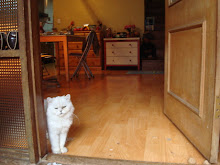
She used to meow more than any other cat we had and Ammi (my mom)was the guardian of her right to free speech, I mean meow. She had a very sweet meow and thus ammi would say "ga, ga, bachhay - koi baat nahi hai" and then would pat her". Yes, all she needed from Ammi were the few words of appreciation and a loving touch.
By the way, in Urdu (Pakistani language) 'ga, ga' means 'sing, sing' literally!

Gaga, was the sweetheart of the family for years and back then Lady Gaga was NOT known.

Martial Arts..

Friday, January 21, 2011

Brian LARA Lives Here.....


...yes...here in Port of Spain, the capital of Trinadad and Tobago, a Windward Island of the Caribbean(the natives call it:Trini or TT). It is only 11 km from Venezuela.

As soon as I got off the plane at the Piarco Intl. Airport and was heading towards hotel, the driver decided to brief me on some "important facts" about Trinidad and Tobago in general and Port of Spain in particular such as their history & culture. He covered all the tangible and intangible assets with great pride and needless to say, he had questions for me as well.

His first revelation was about LARA: "Sir Brian Charles Lara, the 'best' batsman in the world lives very close to the hotel (Lady Young Road)where you are gonna stay" he said. He advised me to take the opprortunity of seeing Lara's house for sure.(During my stay, I heard Lara's name being mentioned over and over again plus people asked me if I saw his house yet or not? Finally, I decided to walk up the small hill where they had only 2 houses and I took pictures of both. Later on, the the hotel manager identified for me his house, which is on the right side (made of red bricks). I saw a lot of activity in both the houses and the one that turned out to be Lara's house - I saw two men on the terrace - both looked like Lara but as soon as the man tried to say something to me from the terrace-I ran away. Anyhow, nobody call him Brian Lara as we know him they absolutely add 'Charles' and say his full name with a prefix: Sir. Everybody loves him. I was confused by the fact that why doesn't he live in the West Indies? Well, for the answer-google is an easy option ;D

Lara is all over the place; on the walls, on the billboards, at the bus stops, airport, display windows, malls: selling this and selling that - playing yet another long innings of a differnt sort! Even in the lobby of the hotel, I saw a huge framed photograph of him with Obama, teaching him how to bat?

For more on Lara HERE

Well, back to the driver- who's second revelation was: "Port of Spain has the world's largest roundabout." he added. I later found out that it's name is Queen's Park Savannah roundabout - which is also a venue of one of the world's "best" Carnivals. Trinidad and Tobago hold this carnival every February according to the driver.

The third revelation: "Wasim Akram is the "best" baller of the world"...yes he was, I added. I noticed that Waseem Akram is synonamous to Pakistan or vice versa and I felt pretty good.

People in Port of Spain are very friendly and helpful at almost all levels - it is worth going there and during my stay, I made friends and have beautiful memories to charish.


p.s: Second last picture is Lara's house ( itinerary to Lara's place was given to me by 2 young school boys. One has to go uphill to have a closer view - you will pass by the zoo, botanical gardens and the presidency toget to this hill. "

Thursday, January 20, 2011

Picture of the Day: Flower Girls


Beautiful indeed!
I hope that one day all the children around the world can attend schools & actually blossom!
Picture Credits: Syed Shahid Mahmood
Website: http://www.pakpositive.com/photos/page/3

Embrace Life!


Wear seat belts and love life..

Drive safe!

credits@ Deiya

Thank You Post Office...


....I miss those good old days when we used to wait for the letters and used to have fights over the ownership of the stamps pasted on them!
Seeing a postman was always an ultimate delight.
More so were the moments when letters were opened....worth an effort!
These letters, cards, parcel etc. used to reach us safe and sound travelling thousands of miles and changing hundreds of hands - finally at our door steps.
I MISS THOSE MOMENTS!
Ammi - thanks for keeping the tradition alive.
Thank you everybody -around the world at the Post Offices for making our day special!

p.s:A parcel I sent by EMS reached its destination in the US with 2 days and half. We are all so glad - Yeay!!

Wednesday, January 19, 2011

10 Minutes Meal...


.....yes and yet HEALTHY!

It never took more than 10 minutes. Cost a fraction of what you'd pay at a restaurant in Seoul. A simple cup of noodles at 7 Eleven here costs about $2 US.

It is great that I like Kimchi and on top, I have always got a regular supply of homemade Kimchi(Korean pickle) by my friend's mothers which of course is different in taste, texture and quality. The ones served in university cafetarias' are nothing but an unbalanced combination of salt, red pepper powder and cabbage.

Quality of food served at a restaurant can be determined only by the quality of Kimchi served there. If they are not serving a good Kimchi then it means that they can NOT serve a good meal!

JOB OPPORTUNITIES IN POLITICAL SCIENCE

1: School of Business Faculty Openings at SEJONG University, Seoul, Korea

To maintain our excellence, the Sejong University School of Business, located in Seoul, South Korea, is seeking academically qualified faculty.

The School of Business invites applicants with outstanding academic accomplishments for full-time faculty positions in all areas including Marketing, Finance, Management/Organizational Behavior, Information Management, Accounting and other business-related areas.

Visiting as well as tenure track appointments will be considered. The positions require a doctorate/terminal degree from an accredited institution. Salary and rank will be commensurate with education and professional experience. Housing and a travel allowance may be provided. Native English speaking abilities are preferred.

Please submit a complete and current curriculum vitae as well as names, addresses, telephone numbers, and email address of references. Send a cover letter of interest and the above materials to:

Dr. Theodore Wallin, Dean of Graduate School of Business
Sejong University 98 Gunja Dong, Gwangjin-Gu, Seoul, 143-747 Korea
E-mail: towallin@sejong.edu Homepage: www.sejong.ac.kr
Telephone: +82-2-3408-3046, +82-2-3408-3990 Fax: +82-2-3408-3400


2:PENN PROGRAM ON DEMOCRACY, CITIZENSHIP, AND CONSTITUTIONALISM
POSTDOCTORAL FELLOWSHIP

CALL FOR APPLICATIONS - 2011-2012 Academic Year
Application Deadline: March 18, 2011

The Penn Program on Democracy, Citizenship, and Constitutionalism (DCC) invites applications for a one-year DCC Postdoctoral Fellow in any discipline whose research is pertinent to the Program's 2011-2012 theme, "Corporations and Citizenship." The Program welcomes both empirical and normative scholarship, focused globally or on particular nations, regions, or communities, that explores the various ways that modern corporations are acting and should act as legal and social citizens, as well as the implications of modern corporate statuses and conduct for democracy and constitutional governance at local, national, and international levels.

Eligibility is limited to applicants who will have received their Ph.D. within five years prior to the time they begin their fellowship at Penn (i.e. May 2006 or later). Application deadline: March 18, 2011.

For guidelines and applications, see the School of Arts and Sciences website [http://www.sas.upenn.edu/deans-office/DCCApplicationGuidelines] or write Office of the Dean, School of Arts and Sciences, University of Pennsylvania, 1 College Hall, Rm. 116, Philadelphia, PA 19104-6377. For more information on the Penn Program on Democracy, Citizenship, and Constitutionalism, see the DCC Program website, [http://www.sas.upenn.edu/dcc/] or contact DCC Program Chair Rogers M. Smith, Christopher H. Browne Distinguished Professor of Political Science, rogerss@sas.upenn.edu.

The University of Pennsylvania is an equal opportunity/affirmative action employer.

3: Assistant, Associate or Full Professors - Political Economy & International Relations, Humanities & Social Sciences

Zayed University, a premier university in the United Arab Emirates, is an innovative institution based on an international model of higher education. With 750 faculty and staff serving 5,900 students across two main campuses - as well as satellite locations - in Abu Dhabi and Dubai, the University prepares graduates to become leaders in government, business, civil society, and family life. Zayed University is fully accredited in the U.A.E. as well as by the Middle States Commission on Higher Education in the U.S.A.

The Opportunity

The Department of Humanities and Social Sciences invites applications for a position in Political Economy and International Relations of the Middle East and/or Arab Gulf States for the International Affairs stream of its International Studies program. Candidates should have a Ph.D. in political science, political economy, international relations or a closely related field. The capacity to teach and research in an interdisciplinary environment is highly desirable. Evidence of teaching ability and experience is important, including potential to supervise Capstone thesis projects. The teaching load will also include one or more courses in the Colloquy on Integrated Learning, the University's core curriculum.

The Requirements

A Ph.D. from a recognized university.

The Benefits

The University's benefits package is highly attractive, with competitive salaries free of tax in the United Arab Emirates, housing, a furniture allowance, annual vacation airline tickets for the employee and immediate family, educational subsidies for children and subsidized healthcare for the employee.

To Apply

Please visit our website http://www.zu.ac.ae and click on 'careers' to be directed to our Employment website. In addition to completing the online application form, attach a cover letter and a current CV, the names and contact details of three referees, a statement of undergraduate teaching philosophy, and a statement of scholarly and creative interests, particularly as they might apply to the Middle East, and as to how they might involve undergraduate students. If possible, also include student or departmental teaching evaluations. The review of applications will begin February 1, 2011.

Tuesday, January 18, 2011

Itaewon Islamic Street in Seoul


A consumer shops for fabrics at Step-In, a clothing and fabric shop on Itaewon Islamic Street.
Salam Bakery, a small store on the left side of the road leading toward the Seoul Central Masjid in the Yongsan District, was crowded with customers last Thursday afternoon.

Among those waiting were two Muslim men from Sudan in line to purchase bread and a Korean couple with curious eyes who were gazing at the baklava, bite-sized cakes made with nuts and honey.

“Non-Muslims interested in ethnic food also come to my shop,” said Jinee Jung, who runs the bakery specializing in Syrian-style cakes. “Still, the Muslims living on this street or those who pass through this street to pray at the mosque are my major customers. My bakery sells them halal confectionaries, which Muslims can buy without fear of violating Islamic law.”

“Halal” is an Arabic term that means “permissible” under Islamic law and includes objects or actions. The rules about food are probably the most familiar to non-Muslims.

Among these, the most rigorous rules for food are applied to meat. Halal meat excludes pork and many other sorts of meat and, in addition, requires that rigorous procedures for slaughter be followed, such as a quick killing to minimize the animal’s suffering.

To make the bakery’s halal cakes, animal oil and other animal ingredients are avoided or used sparsely in the bakery’s recipes.

“This is the busiest season for us,” Jung said. “During Ramadan, Muslims refrain from eating and drinking from dawn until dusk. They tend to eat more pastries and sweets at night than on ordinary days so I will keep the shop open for 24 hours a day during Ramadan, although I will let my chef, who is from Damascus in Syria, rest during the day because he cannot eat or drink during that time.”

Ramadan began on Saturday and continues for about a month.

Across the road from the Salam Bakery stands Salam.com, an electronics store that deals in various electronics goods, including a cell phone with an alarm set to ring for daily prayers.

There are also several travel agencies here, with signs in Korean and Arabic, and sometimes in English.

Further along the street there is a clothing and fabric shop called Step-In, whose Afghan owner welcomes anyone who steps into the store. In front of the store, mannequin heads wearing hijab, or head coverings, and pretty shoes are displayed.


A customer browses through the books at the Islamic Book Center. Lower right: Workers at Salam Bakery put out Syrian and Turkish cakes.By Jeon Min-kyu
One of several grocery stores on the street has a sign that says “We now have halal duck.”

This Islamic world in central Seoul is commonly called Itaewon Islamic street. The street started with a few grocery stores and restaurants selling halal food near the Seoul Central Masjid, the mosque established there in 1976.

Because of the halal food regulations, eating is not an easy job for Muslims in Korea, where the percentage of the Muslim population is not very large.

“I’m nearly becoming a vegetarian, living here,” sighed Shiraz Subeh, an Ewha Womans University student from Palestine. She had come to the Seoul Central Masjid for her daily prayers, which is one of her obligations as a Muslim. The mosque has a separate area where women can pray.

The shops on Itaewon Islamic Street have met the nutritional needs of many Muslims in Korea. There is a butcher selling halal meat next to the entrance of the masjid, as well as several grocery stores and restaurants in the neighborhood.

“We can do our five daily prayers either at the masjid or at home, but I come here from time to time to pray, to meet friends and to shop in the neighboring stores,” Subeh said.

But there is much more here than food.


Subeh and her friend from Kyrgyzstan, Nazik Sultanbekova, who is also studying at Ewha, dropped by the Islamic Book Center to purchase a copy of the Koran in Spanish for a Spanish-speaking friend.

Muneer Ahmad, the bookstore’s chief executive officer, said he opened the store three years ago to increase awareness about Islam among Koreans and the larger foreign population.

“Many people may misunderstand, but Islam emphasizes open-mindedness, tolerance and peace, and many Muslims are open-minded,” he said. “I am from a Muslim family in Kashmir, India, but I have not become a Muslim just because my parents are Muslim. I read the scriptures of various religions and then I decided to be a Muslim.

“I recommend that people do the same to become familiar with the similarities and differences between different religions and to gain a true understanding of them.”

The bookstore has Korean and English translations of the Koran and other Islamic books. For English-speakers interested in studying Arabic there are books written in both English and Arabic.

There are many things to learn on this street. Most of the Muslims here are kind and eager to tell people who ask about Islam. Ahmed, the bookstore owner, and Jang Sun-kyung, who were at the mosque to pray, were two such hospitable folks. Jang, the former head of the female devotees’ group at the masjid, converted to Islam after spending 20 years exploring other religions. Her story is rather unique because, unlike many other Korean converts to Islam, Jang came to Islam without having traveled to the Middle East.

The number of Muslims in Korea is gradually increasing, because more Koreans have become interested in the religion and the culture. The number of workers arriving here from Islamic countries is also increasing. The Korea Muslim Federation, which has its headquarters in the masjid, estimates there are about 35,000 Korean nationals who are Muslim, in addition to the many other Muslims among the foreign population.

Credits: This article was published in JoongAng Daily.

Tips for Students in Korea


There are a few things I would like to recommend to students who are already in Korea or are planning to study here:
1) Learn Korean, try your best and do NOT take it for granted.
2) Korean language proficiency can open many doors of opportunities which you'd miss otherwise.
3) Hang out with Korean students or the lot who do not mind speaking Korean - it is hard to find such people because the natives indulge themselves in practicing English - more often than not.
4) Choose a major - which interests you & you are passionate about.
5) Korea is becoming more diverse in the choice of schools for kids from Pre-school to High School - which wasn't true a few years back... therefore, if you have kids - it should not be a big problem to find a school of your choice and in your budget (for people in doctoral, post-doc or research programs).
6) Get yourself enrolled in extra curricular activities - martial arts, music, painting and many other choices provided by the Korean government, NGO's or universities themselves.
7) Stay positive.
8) No matter what religious background you have or what sort of baggage of restrictions you have in terms of food choices or interaction with people - Korea has it all.
* Itaewon (Line6) is an area where you can find all sort of groceries from around the world-including 100% Halal food @Foreign Food Store. This store also owns Foreign Food Restaurants located on the same street. Itaewon has the highest number of halal food restaurants in Seoul and the cost is reasonable.
* Haehwadong(Line 4) -has a street market every Sunday specializing in Filipino goods-give it a shot.
* Dongdaemun (Line 2,3,4,5) - has pretty much everything from huge shopping malls to street markets. It is also considered as the center of whole sale vegetables and fruits markets as well as an area specializing in clothing, footware, leather products and the biggest socks making center in Asia.
* Jaegi Dong" near Cheongneangni (subway line no:1) is another interesting place to explore. It has fruits and veges usually sold in a slightly bigger quantity but at a really low rate. In such a case you can split the price and the produce between freinds. This area is the main supply center to the entire Seoul.
9) You can also volunteer - there are many options like orphanages, old age centers, foreign community centers, translators, teaching positions for the underprivileged children at various schools, cultural exchange teachers and so on. Options may be available within your field of study as well.So stay informed.
10) Avail the option of internship - both paid/unpaid as well as domestic/international- which is provided by almost all universities during the term breaks. It is a good way of networking as well as future job prospects.
11) Seoul's student neighborhoods and areas of activity are:
- Sinchon (line:2) center of learning with four major universties (Ewha, Yonsei, Hongik, Sogang) with a student community of about 200, 000 bustling with a great number of restuarants, cafes, clubs, book stores, libraries and shops.
- Second area is again Haehwa : it has International Student Hostels etc.so again, it is good for the people with budget & a willingness to try fusion culture.
- Another area is Gangnam (line 2) and Sadang also on line 2....a huge number of students hang out there - a real treat indeed.
- Seoul has about 56 universities in all and the list is long. All university localities have their own distinct culture and budgeted outlets...do your research.
12) Seoul in particular and Korea in general has the highest number of Womens' universities and among them Ehwa is considered as one of the oldest women's university of Asia. If you have reservation to study in a women's university then there is a plenty of choice for one to choose from.
13) There used to be an option of National Insurence but now it is being replaced by AVG, ask your admin office - it is important because medicare is very expensive, one trip to a doctor would cost you minimum 50 dollars (US). If you do NOT have any health insurence than you have a choice of 'absolutely free' medicare at any of the Migrant Centers in and around Seoul. Please call first before heading out. Oriental medicine, dentistry and general medicine are the areas that they cover.
14) Last but not the least, contact:'Seoul Global Center for Foreigners (SGC)'. It is the best source of information and on top, they are extremely efficient. You can either visit SGC personally (it is located near the City Hall on line 2, exit 5)or can check their website at http://global.seoul.go.kr


ENJOY YOUR STAY AND ALL THE BEST!
¸...¸ ___/\_____ ____
,·´º o`·, /__/__/\__//____/\
```)¨(´´´ | | | | || ||l±±±± |
¸,.-·²°´ ¸,.-·~·~·-.,¸ `°²·-. :º°

Monday, January 17, 2011

Korea and Taekwondo

It all starts with : Mind, Spirit and Body.. Please click on the image to have a readable image :D If you want to know more about Taekwondo please visit the site below:

http://www.kukkiwon.or.kr

Taewondo is a national sport of Korea. Children start learning it from kindergarten and by grade 5, almost all of them have black belts which is a mandatory part of their curriculum, irrespective of gender.

http://www.wtf.org

It does not stop there but many universities have undergraduate/graduate programs. Among them Kyunghee University (KHU) stands out. It is considered the top universities in the world to impart specialized education on Taekwondo where you can persue a Doctorate in this sport the only university that offers the program. They have state of the art facilities and generous funding by the Korean government. KHU also offers short courses in different spheres of Taekwondo. For more inforamtion visit:

http://www.kyunghee.edu/international05.php

Kyunghee has many former and current World champions, Olympic and Asian Champions in their faculty and student body.

If you visit Korea, you can call their office and personally visit the facilities and see the demonstrations etc.

For more click on the video below:

Korean Hospitality

It was a New Year Eve and Esther invited some friends over to her place. I don't know her well except that I met her at the Civic Center in Unjeong Dong once - this happened in August 2010.
I also found out that we have a common friend-Jiyoung-she came to pick me up from my place on a really cold and windy day and as is said: the rest is history!
:-)
Met great people, had delicious food and the view from her house was awesome.
Thanks Esther and Jiyoung Shi.
고마워요!